
Upgrading your smartphone used to be a simple decision: you picked a device with a slightly sharper camera or a slightly larger screen. Today, average users keep their phones for three to four years, making a phone purchase a long-term investment.
With modern phones blending hardware, cloud services, and on-device machine learning, knowing what specs actually affect your daily life helps you avoid paying for features you do not need. Whether you are looking at budget options, mid-range devices, or flagships, here are the 10 key features smart buyers check before upgrading.
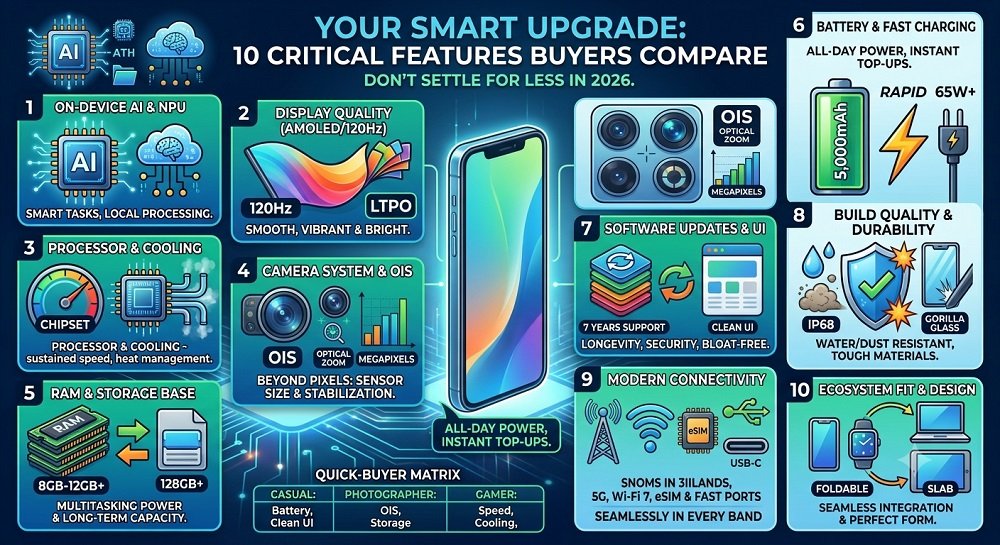
1. On-Device AI & Smart Features
Artificial Intelligence on phones has moved beyond simple voice commands. Modern chipsets feature dedicated Neural Processing Units (NPUs) that run AI models right on your device rather than sending everything to a server.
- Real-time translation & transcription: Translate phone calls on the fly or transcribe voice memos with automatic speaker labels.
- Photo editing tools: Move objects, remove shadows, or unblur old photos without needing complex desktop software.
- Privacy benefits: Processing data locally keeps sensitive details like messages, notes, and photos private on your phone.
2. Display Quality: Panel Type, Refresh Rate, and Outdoor Brightness
Your display is what you interact with every single time you pick up your phone. The numbers on the box tell a clear story once you know what to look for.
  Display Quality Breakdown
  ├── Panel Type     ──> AMOLED / OLED (true blacks & vibrant colors)
  ├── Refresh Rate   ──> 120Hz (smooth scrolling; LTPO saves battery)
  └── Peak Nits      ──> 1,200 to 2,000+ nits (crystal-clear in direct sunlight)
- AMOLED over LCD: AMOLED or OLED screens offer deep black levels, higher contrast, and better battery efficiency during dark mode.
- 120Hz Refresh Rate: Higher refresh rates make web browsing and app switching feel noticeably smoother. An LTPO panel automatically scales down when looking at a static photo to preserve battery power.
- Peak Brightness: Look for a screen rated at 1,200 to 2,000+ nits so you aren’t squinting while using your phone outdoors under bright sunlight.
3. Processor Power & Thermal Efficiency
Raw benchmark scores don’t tell the whole story.A fast processor needs proper cooling to maintain its speed during extended tasks like video rendering or gaming.
- Leading Chipsets:Qualcomm’s Snapdragon 8 and 7 series, Apple’s A-series silicon, and MediaTek’s Dimensity 8000/9000 lines provide reliable balance between speed and battery efficiency.
- Vapor Chamber Cooling: Look for hardware thermal management. Good heat dissipation keeps the phone cool, stops game frame rates from dropping, and prevents rapid battery degradation.
4. Camera System: Sensor Size, OIS, and Versatility
High megapixel counts look great in marketing materials, but sensor size and lens physics matter far more for actual photo quality.
| Camera Spec | Why It Matters | What to Aim For |
| Sensor Size | Larger sensors physically capture more light for cleaner night shots. | $1/1.56\text{”}$ sensor size or larger |
| Optical Image Stabilization (OIS) | Mechanically holds the lens steady to eliminate camera shake. | Essential on primary & telephoto lenses |
| Lens Setup | Gives you flexiblity to switch focal lengths without losing quality. | Main Wide + Ultra-wide + Optical Telephoto |
5. RAM & Internal Storage Baselines
Apps and media files continue to grow in size. Choosing insufficient memory or slow storage speeds can noticeably slow down your device over time.
- RAM (Multitasking Memory):8GB of RAM is the recommended baseline for smooth everyday performance, while 12GB to 16GB is ideal for heavy gaming and long-term future-proofing.
- Storage Capacity: Avoid 64GB models. 128GB works for light users, but 256GB provides plenty of room for 4K video clips, offline music, and heavy apps.
- UFS Storage Type: Check for UFS 3.1 or UFS 4.0 storage ratings, which deliver faster read/write speeds so apps load instantly.
6. Battery Capacity & Fast Charging Tech
A high-end phone isn’t very helpful if it runs out of juice by mid-afternoon.
- Capacity:Look for a 5,000mAh battery capacity baseline for reliable, full-day endurance.
- Charging Speeds: Fast charging support (ranging from 30W to 67W+) allows you to top off a low battery in about 20 to 30 minutes.
- In-Box Charger Check:Always verify whether the brand includes a charging block in the box or if you need to buy one separately.
7. Long-Term Software Support & UI Cleanliness
Software updates keep your device secure, bring new features, and help maintain resale value over time.
- OS Commitments: Major manufacturers now offer 4 to 7 years of operating system upgrades and security patches.
- Clean Software (UI): Choose an operating system with minimal pre-installed “bloatware” software or aggressive system ads so your phone remains responsive.
8. Build Quality & Durability Ratings
Accidents happen. Physical durability dictates whether your phone survives a sudden drop or an accidental splash.
- Ingress Protection (IP Rating):Look for an IP68 rating, which protects against complete dust immersion and water submersion.
- Front Glass: Glass technologies like Gorilla Glass Victus or Ceramic Shield add solid drop and scratch resistance.
- Frame Materials: Aluminum or titanium frames offer strong structural integrity compared to lightweight plastics.
9. Connectivity Standards (5G, Wi-Fi 6/7, and eSIM)
Modern wireless capabilities ensure stable signal reception in crowded places and fast home network speeds.
- Multi-band 5G:Make sure the device supports multiple 5G bands for consistent network coverage across carriers.
- Wi-Fi 6E / Wi-Fi 7: Delivers higher network bandwidth and lower latency when connected to modern home routers.
- eSIM Support: Allows you to activate digital cellular plans instantly when traveling internationally without swapping physical SIM cards.
10. Ecosystem Integration & Overall Value
Before finalizing your choice, evaluate how well the smartphone fits into your existing setup and daily habits.
- Ecosystem Synergy:If you already use a smartwatch, tablet, or laptop from a specific brand, staying within that ecosystem makes sharing files, syncing notifications, and pairing earbuds practically effortless.
- Price-to-Performance Ratio:Compare trade-in options, carrier promotions, and seasonal discounts to get maximum value out of your budget.